Learn to Fly


Welcoming Newcomers to Fixed Wing R/C Flying
People who are new to the hobby are warmly welcomed at the club. We strive to create a supportive environment where beginners can confidently learn and develop their skills in R/C flying.
How Flying Tuition Works
Club Instructors
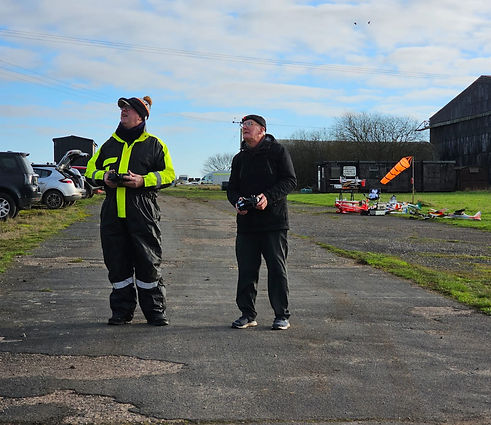
There are four dedicated members in our club who are happy to act as instructors for fixed wing R/C aircraft. These volunteers generously offer their time to tutor new RC model flyers, making use of dual transmitter systems to ensure safe and effective training sessions.
R/C flying tuition is conducted using your own equipment. For those who choose the electric route, which is the most popular option, you will need to have a suitable model aeroplane, radio equipment, flight batteries, and a charger.
The initial cost of starting the hobby is estimated to be between £500 and £600 for a very basic setup. To help newcomers get started, we offer trial flights. These trial sessions give you the opportunity to visit the club, try flying an R/C aeroplane, and receive advice on suitable setups.
If you had fun during the Trial Flights and are interested in getting involved with this amazing hobby, you will first need to get a model aircraft. This should be a trainer model, as it offers the most suitable characteristics for learning to fly

Routes into R/C Flying
There are various routes to take when starting out in R/C flying, each offering different levels of convenience and flexibility for beginners.
Ready to Fly (RTF) Models
The easiest entry point is with a Ready to Fly RTF model. Manufacturers such as E-flite offer many RTF options, which typically consist of a fully equipped EPO foam model aeroplane. These packages include a motor, speed controller (ESC), propeller, servos, radio receiver, and a basic radio transmitter. Some RTF sets also come with one flight battery. With this setup, all that is required to get airborne is a Li-po battery charger.
Bind and Fly (BNF) Models
The next simplest option is the Bind and Fly BNF model. This is similar to the RTF package but does not include a radio transmitter or Li-po battery; however, all other components remain the same. The idea behind BNF is that you purchase a compatible R/C radio and bind it directly to the model. One drawback of both RTF and BNF systems is that they tie you into the manufacturer's proprietary radio system. For example, E-flite utilises their Spektrum brand, which is popular within the R/C community—largely due to the widespread availability of BNF models.
Plug and Play (PNP) Models
The third, and possibly the most common, option is the Plug and Play (PNP) model. Like the previous types, these are typically EPO foam model aeroplanes and come equipped with servos, a motor, an electronic speed controller (ESC), and a propeller already installed. However, they do not include any radio equipment, giving you the flexibility to choose and use your own preferred radio system. To complete a PNP model and make it flight-ready, you will also need to provide your own charger, flight batteries, radio transmitter, and receiver.

Balsa Model Aircraft Options
These models offer greater customisation and build satisfaction, coming in several distinct forms.
Almost Ready to Fly (ARTF)
The Almost Ready to Fly (ARTF) category can be somewhat misleading by name. Although the airframe will arrive built and covered, some assembly is still required. Typically, you will need to attach and glue the tail and wings, install control surfaces, and fit essential components. For electric-powered setups, you must purchase and install at least four servos, a brushless motor, an electronic speed controller (ESC), a Li-po flight battery, and a propeller. If opting for an internal combustion engine (often referred to as nitro), you will need servos/receiver battery, the engine itself, a fuel tank, and a glow starter. Regardless of power type, a complete radio system and charger are necessary.
Kit Built
Kit built models follow a similar approach to ARTF, but you are responsible for constructing the entire airframe yourself. This method was once the standard entry point for hobbyists. After building the aircraft, enthusiasts would join a club to learn to fly. Kits usually provide plans and pre-cut parts, resembling a large wooden Airfix kit. Once assembled, the model must be covered before fitting out with the necessary radio and power components, as described for ARTF models.
Plan Built
Plan built aircraft involve building your model from supplied plans, without the convenience of pre-cut parts. However, CNC-cut short kits are sometimes available, which can save time and effort, especially for components like wing ribs. The remainder of the build process mirrors that of the kit-built option, but with more hands-on involvement in shaping and cutting each part.
Scratch Built
Scratch built models require you to design and construct the aircraft entirely yourself, starting from raw materials. As the name suggests, every aspect of the build is undertaken independently, offering the highest level of customisation and craftsmanship.

Responsibility and Risk During Training
While every effort is made by your trainer to ensure the safety of your aircraft during training sessions, it is important to recognise that accidents can happen. Despite the trainer’s best intentions, there are circumstances in which damage to your model may occur and cannot be prevented.
Neither your trainer nor any other club member who is asked to fly your aircraft accepts any liability whatsoever for any damage that may befall your model during these flights. The responsibility for any harm or loss rests solely with the aircraft owner.
Training for beginners is provided and required for participation with the club. However, any damage sustained to your model aircraft during instruction, or when flown by another member on your behalf, is entirely at your own risk. Neither the club nor its individual members will accept responsibility or liability for such incidents.